Table of Contents
Most schools don’t struggle because they lack marketing ideas. They struggle because they don’t have a system that consistently turns interest into admissions.
They run a few ads, post on Instagram randomly, maybe optimize their website once — and then wonder why inquiries are inconsistent.
That’s exactly where digital marketing for schools changes the game.
This guide isn’t a generic overview. You’re going to learn how to build a working enrollment engine — the kind that brings in qualified parents, nurtures them and converts them into admissions.

What is Digital Marketing for Schools?
Digital marketing for schools is the use of online channels—search engines, paid ads, social media, and email—to attract, engage, and convert prospective students and parents into enrollments.
But here’s the part most blogs won’t tell you:
It’s not about “being online.”
It’s about building a predictable admission funnel.
That means:
- Getting found when parents search
- Showing up where they spend time
- Capturing leads (not just traffic)
- Nurturing trust before admission decisions
If your marketing doesn’t do all four, it’s broken.
Why Schools Need Digital Marketing in 2026
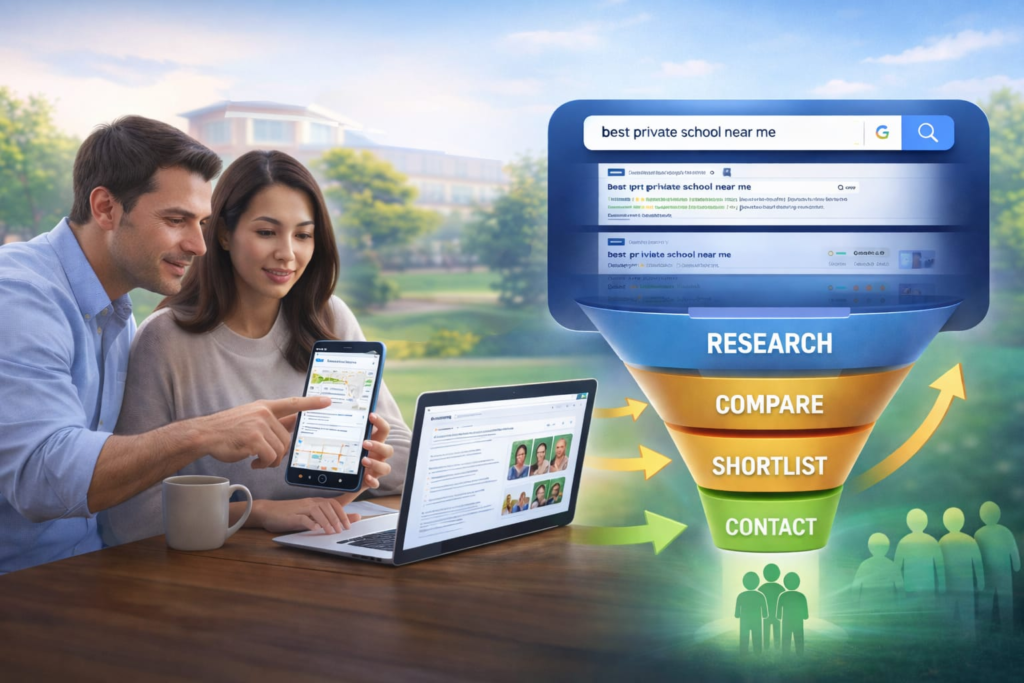
Parents don’t walk into schools blindly anymore. They research. They compare. They shortlist online.
According to trends observed across platforms like Google Analytics and search behavior data, over 80% of parents research schools online before contacting them.
That means if you’re not visible digitally, you’re invisible — period.
But visibility alone isn’t enough.
Here’s what actually matters:
- Ranking on Google when parents search “best private school near me”
- Showing ads when admission season peaks
- Having a website that converts visits into inquiries
- Building trust through consistent content
At this stage, you should already be thinking:
“Are we getting traffic but not inquiries?” or “Are we not even getting traffic?”
Because the strategy changes depending on that answer.
Biggest Challenges Schools Face Online
Most schools fall into predictable traps. If you recognize any of these, don’t ignore them.
They:
- Have a website but no lead capture system
- Spend money on ads without tracking ROI
- Post on social media without a strategy
- Ignore local SEO completely
- Depend only on word-of-mouth
The harsh truth?
You don’t have a marketing problem.
You have a system problem.
Fix the system, and admissions follow.
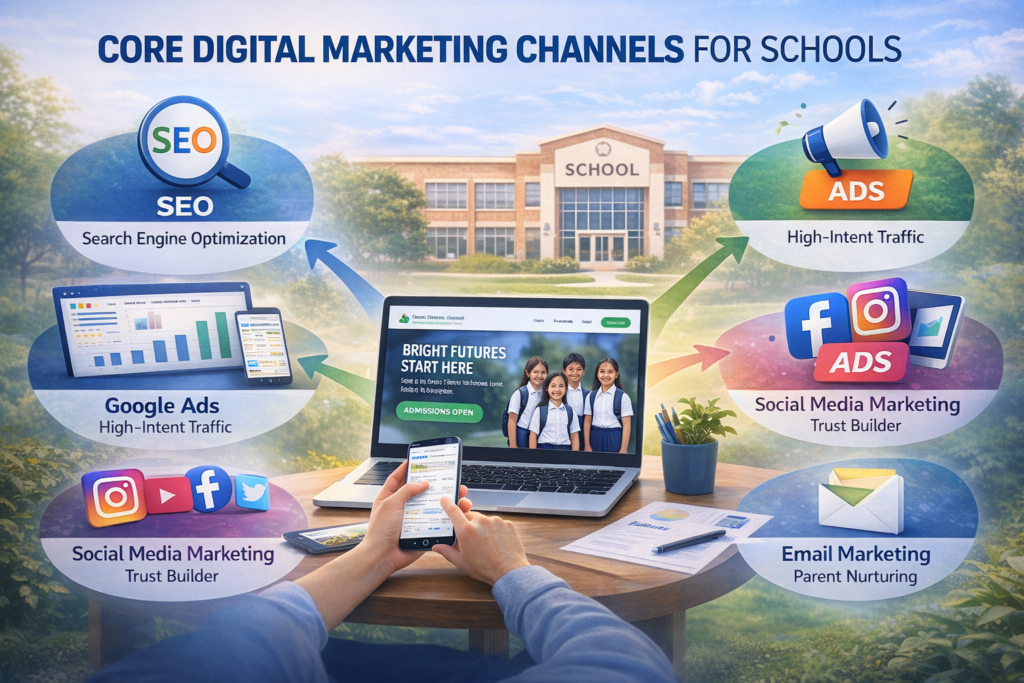
Core Digital Marketing Channels for Schools
Let’s break this down properly.
SEO (Search Engine Optimization)
SEO is how you show up when parents search on Google.
But don’t just “do SEO.” Do intent-based SEO.
Start with keyword research using Semrush or Ahrefs.
Go to:
- Keyword Overview
- Enter: “schools near me”, “best school in dallas”
- Check:
- Search volume
- Keyword difficulty
- Intent
Then move to Google Search Console:
- Go to “Performance”
- Identify keywords you already rank for
- Improve those pages first (low-hanging fruit)
Now here’s the real execution most skip:
You create pages like:
- “Best Private Schools in Dallas
- “Top International Schools in Dallas”
And optimize them with:
- Internal links
- FAQs
- Location keywords
- Schema markup
If you’re serious about dominating locally, read this breakdown on local SEO strategies for small businesses the same principles apply directly to schools.
Google Ads (High-Intent Traffic)
SEO takes time. Ads give instant visibility.
Go to Google Ads.
Create a campaign:
- Objective: Leads
- Type: Search campaign
Target keywords like:
- “school admissions open”
- “private school near me”
- “best school for kids in Dallas”
Now here’s where most schools waste money:
They don’t track conversions.
Fix that by:
- Setting up conversion tracking
- Connecting with Google Analytics (GA4)
Monitor:
- Cost per lead
- Click-through rate (CTR)
- Conversion rate
If your cost per lead is high, don’t panic—optimize:
- Ad copy
- Landing page
- Targeting
Social Media Marketing (Trust Builder)
Your school’s online presence decides enrollment before parents ever contact you.
They check:
- YouTube
If your school looks inactive, it kills trust.
Use platforms like:
- Instagram for daily updates
- YouTube for campus videos
- Facebook for parent engagement
Execution matters here.
Don’t just post randomly.
Create content like:
- Student activities
- Teacher introductions
- Parent testimonials
- Event highlights
If you’re unsure how to structure this, this guide on social media marketing strategies for small businesses gives a solid framework you can adapt.
Meta Ads (Facebook & Instagram Ads)
Meta Ads (Facebook & Instagram) are one of the fastest ways to generate qualified student inquiries—but only when backed by the right targeting, creatives, and funnel.
Campaign Setup
- Start with one of these two campaign types:
- Lead Generation Campaigns (using instant forms inside Meta)
- Conversion Campaigns (sending users to a landing page)
- If your website is weak, use Lead Forms
If you have a strong landing page, use Conversion Ads
Target:
- Parents aged 28–45
- Within a 10–15 mile radius of your campus
- Interests: parenting, child education, private schools
Test these ad formats:
- Video ads (campus walkthrough)
- Carousel ads (facilities, awards, program highlights)
Track cost per lead and engagement rate. Scale what works. Pause what doesn’t.
Email Marketing (Most Ignored, Highest ROI)
This is where you convert inquiries into actual admissions.
When a parent fills out your form, don’t just say “Thank you.” Build a nurture sequence:
- Day 1: School brochure + welcome message
- Day 3: Student success story or parent testimonial
- Day 7: Invitation to schedule a campus visit
- Day 14: Reminder + open Q&A offer
Tools to use:
Email marketing delivers the highest ROI of any school marketing channel when done consistently.
Step-by-Step Strategy to Increase Enrollment
Define Your Target Audience
Don’t say “all parents.” Be specific:
- What grade level are you targeting? (K–5, 6–8, 9–12)
- What’s the household income range in your target area?
- What radius are you willing to recruit from?
This drives your ad targeting, messaging tone, and pricing perception.
Optimize Your Website
Your website is not a brochure. It’s a conversion tool.
Must-haves:
- Clear CTAs on every page: “Apply Now”, “Schedule a Visit”
- Mobile-optimized design (60%+ of school website visits are mobile)
- Page load time under 3 seconds
- Simple inquiry form (name, email, child’s grade — that’s it)
- Use Google Analytics 4 to check your bounce rate and identify which pages parents exit without taking action.
Build a Lead Funnel
Your funnel should follow this exact path:
Paid Ad / Search → Dedicated Landing Page → Lead Form → Automated Email Sequence → Campus Visit → Admission
Never send ad traffic to your homepage. Always use a dedicated landing page with one clear goal.
Your landing page needs:
- A compelling headline (“Give Your Child the Education They Deserve”)
- 3–5 key benefits
- 1–2 parent testimonials
- A short, simple inquiry form
Ads Budget Strategy
Start small. Prove the system. Then scale.
Budget | Allocation |
$500–$1,500/month | 60% Google Ads, 40% Meta Ads |
$2,000–$5,000/month | Add retargeting, YouTube pre-roll |
$5,000+/month | Scale top performers, add local display |
Track everything from day one. You can’t optimize what you don’t measure.
At this stage, if managing all this feels overwhelming, that’s normal. This is exactly why structured execution frameworks matter—random efforts don’t scale.
If you’re evaluating support, this guide on choosing the right digital marketing partner helps you avoid bad decisions.
Local SEO for Schools (Most Underrated Channel)
This is where many US schools can dominate quickly — and it’s mostly free.
Optimize your Google Business Profile:
- Upload 15–20 high-quality photos of campus and classrooms
- Keep your hours and contact info current
- Post weekly updates (events, achievements, open days)
- Respond to every review — good or bad
Actively collect reviews:
More Google reviews = higher local rankings = more inquiries. Send a direct review link to satisfied parents after key events or enrollment milestones. Aim for 50+ reviews with a 4.5+ star average.
Best Digital Marketing Strategies for Schools
Most schools treat digital marketing as separate activities.
That’s the mistake.
Real growth happens when all channels work together as a system.
The Winning Strategy
High-performing schools don’t rely on just one channel. They combine multiple channels, each serving a specific purpose:
- SEO drives consistent, long-term traffic from search engines
- Paid Ads generate immediate inquiries and visibility
- Social Media builds trust and credibility with parents
- Email Marketing converts leads into actual admissions
No single channel works in isolation—results come from how well they are connected.
How the System Works
Here’s how a typical parent journey looks:
- A parent searches on Google and finds your website (SEO)
- They later see your ad on Instagram or Facebook (Ads)
- They check your social media profiles to evaluate your school (Social Media)
- They fill out an inquiry form
- They receive follow-ups and updates (Email Marketing)
- They decide to visit your campus
This is not random marketing—it’s a structured conversion journey
A Real Example: What $600/Month Can Do
Let’s say a private school in Texas runs its first paid campaign:
- Budget: $600/month
- Campaign: Google Ads for “private school admissions near me”
- Targeting: Parents within a 10-mile radius
- Destination: Dedicated landing page
Results after 30 days:
- 500 clicks
- 50 leads
- 10 new enrollments
ROI calculation:
Metric | Value |
Ad spend | $600 |
New enrollments | 10 |
Average annual tuition | $8,000 |
Annual revenue generated | $80,000 |
ROI | 133x |
That’s not a cost. That’s a growth engine.
ROI by School Type
School Type | Avg. Annual Tuition | ROI on $600 Ad Spend (10 Enrollments) |
Private K–12 | $8,000–$12,000 | 133x–200x |
Charter/Independent | $3,000–$6,000 | 50x–100x |
Preschool/Daycare | $6,000–$15,000 | 100x–250x |
Common Mistakes US Schools Make With Digital Marketing
- Chasing vanity metrics — Instagram likes don’t pay tuition. Leads do.
- No conversion tracking — If you can’t see what’s working, you’re flying blind.
- Generic messaging — “Excellence in education” means nothing. Specifics win.
- Inconsistent posting — Inactive social accounts kill trust.
- Sending ad traffic to the homepage — Always use a dedicated landing page.
Fix these five issues and you’re ahead of most of your competitors.
Best Tools for School Marketing
You don’t need dozens of tools. You need the right ones used consistently.
Tool | Purpose |
Keyword research + competitor analysis | |
Track rankings and fix SEO issues | |
Understand user behavior | |
High-intent paid traffic | |
Social paid campaigns | |
Email nurturing |
How Much Should US Schools Spend on Digital Marketing?
School Type | Recommended Monthly Budget |
Small/independent school | $500–$1,500 |
Mid-size private school | $2,000–$5,000 |
Large institution | $8,000+ |
Remember: budget alone is irrelevant. ROI is what matters.
A well-run $600/month campaign that generates 10 enrollments at $8,000/year each has created $80,000 in annual revenue. That’s not an expense — it’s an investment.
How to Choose a Digital Marketing Agency for Your School
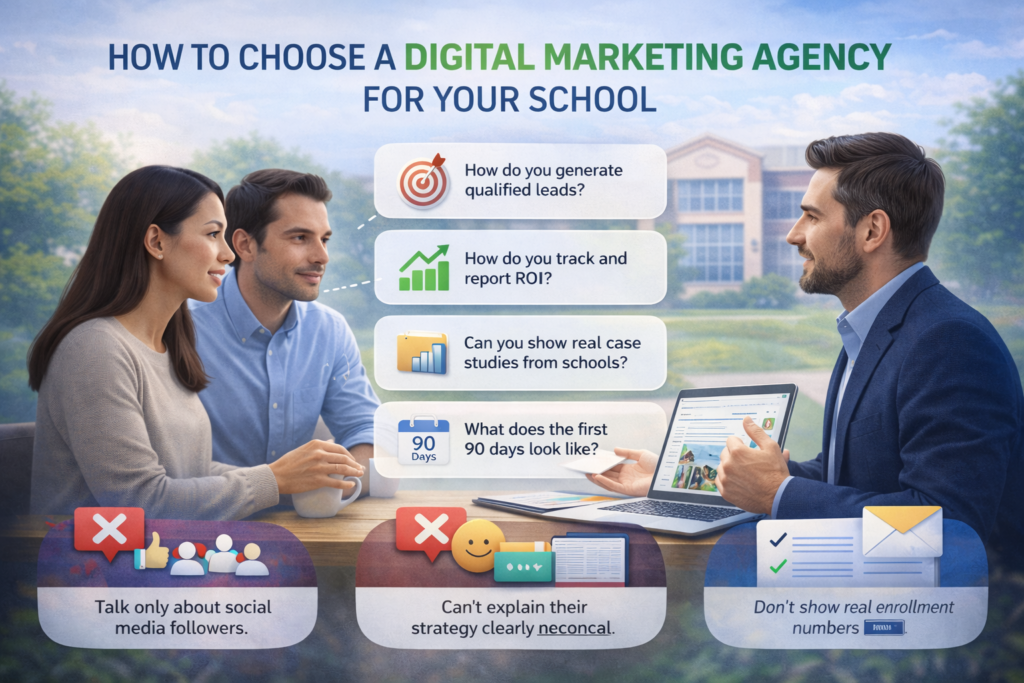
Don’t choose based on promises or follower counts. Ask these questions:
- How do you generate qualified leads (not just traffic)?
- How do you track and report ROI?
- Can you show real case studies from schools?
- What does the first 90 days look like?
Avoid agencies that:
- Talk only about social media followers
- Can’t explain their strategy in plain terms
- Don’t show you real enrollment numbers from past clients
If you’re comparing options, this breakdown of affordable SEO services for small businesses gives a realistic expectation of what you should get.
Conclusion:
Digital marketing has become essential for schools to maintain steady student enrollment. Traditional methods alone often fall short in today’s digital-first landscape, where parents thoroughly research and compare schools online before choosing.
You have two main options. One is to gradually implement digital marketing strategies yourself—enhancing your website, launching targeted ads, and developing a lead generation and follow-up system. This method can be effective but demands ongoing effort, testing, and refinement.
Alternatively, partnering with an experienced agency like Rankraze, which has established systems for attracting and converting school inquiries, can save time and money. Expert guidance helps avoid common pitfalls, minimize wasted ad spend, and speed up enrollment growth.
Ultimately, success depends on execution. Planning is not enough—consistent action, informed decisions based on data, and a solid digital marketing framework are crucial to driving admissions.
FAQs - Digital Marketing for Schools
A school can increase admissions by combining SEO, paid ads, and lead funnels. Start by ranking for local keywords, run Google Ads for high-intent searches, and use landing pages to capture inquiries. Follow up with email nurturing. The key is consistency and tracking conversions, not just generating traffic.
The best strategy is a multi-channel approach: SEO for long-term visibility, Google Ads for instant leads, social media for trust, and email marketing for conversion. Schools should integrate these channels into a single funnel instead of running isolated campaigns.
Schools typically spend between $500 and $5,000 per month depending on size and goals. However, budget should be tied to expected ROI. A well-optimized campaign should generate significantly more revenue than the cost of marketing.
Both serve different purposes. SEO builds long-term visibility and reduces dependency on ads, while paid ads generate immediate leads. The most effective strategy combines both—ads for short-term results and SEO for sustainable growth.
Paid ads can generate leads within days, while SEO usually takes 3–6 months for noticeable results. However, consistent optimization and proper tracking can accelerate outcomes. Schools that commit to a structured approach see faster and more predictable growth.